Refella
An AI product that helps people capture everyday work as structured career evidence they can reuse across CVs, promotion cases, interviews, and social content.
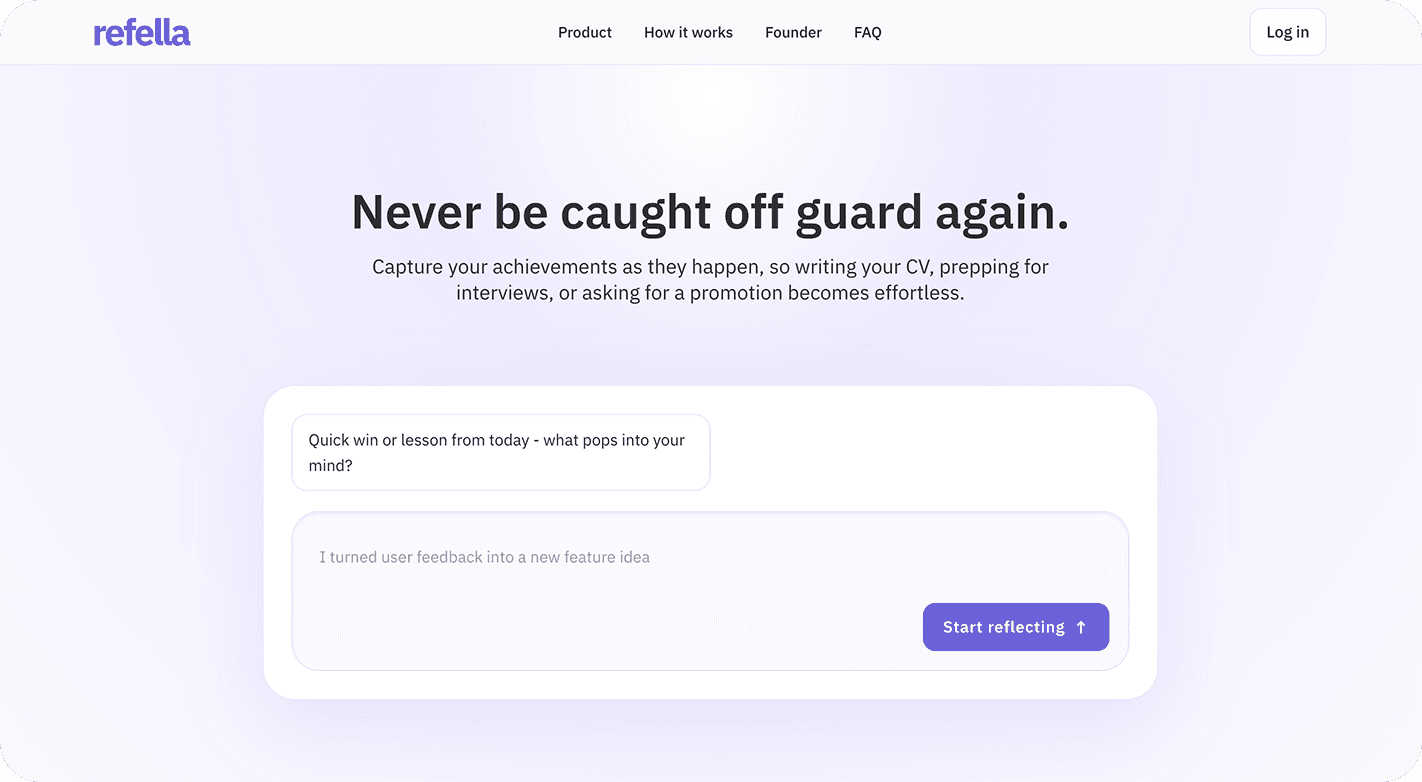
Why this project matters
Refella is the clearest example of how I work as a UX Engineer: I defined the product direction, designed the core interaction model, built the frontend, and shaped the AI system behavior around trust, structure, and usability.
What I owned
- Product direction and UX strategy
- Onboarding and core capture experience
- End-to-end frontend implementation
- Stateful AI interaction design
Why it was hard
- Make the first useful output feel fast and low effort
- Balance cost, latency, trust, and UX quality in AI flows
- Keep outputs structured enough to reuse later
Key product bets
- Value before sign in
- Structured outputs over generic reflection
- Stateful system over freeform generation
- Clear separation between facts and AI suggestions
The problem
Most people do valuable work every day, but very little of it gets captured while it is still fresh.
They fix bugs, improve flows, help teammates, and learn new tools. Then, when they need to talk about that work in a CV, a promotion case, or even a conversation, they rely on memory.
And memory is unreliable. The result is predictable:
Unclear impact
People remember fragments of what happened, but struggle to explain what changed or why it mattered.
Low confidence
When the details are fuzzy, talking about their own work starts to feel uncertain and unconvincing.
Weak proof of value
That makes CVs, promotion cases, and interviews harder because the evidence is incomplete.
The product insight
Refella started as a reflection tool, but the product insight changed as I worked on it.
People do struggle to reflect on their work because they do not naturally ask themselves the right questions.
But the deeper problem is that, by the time reflection happens, the most useful raw material is already missing.
The real issue is not reflection alone. It is helping people capture the right evidence while the details are still available.
So the system needed to help people:
- capture what they actually do
- notice the details that matter
- understand why it matters
- reuse that knowledge later across different contexts
Strategic shift
The goal shifted from reflection to capturing structured, reusable evidence that can power CV bullets, promotion cases, interview stories, and social content later.
Designing the experience
The product is built around one key moment:
Turning a vague input into a usable, structured output.
This moment needed to be:
- fast
- clear
- low effort
User input
"I fixed a bug in onboarding"
Output
Clear, structured statement with impact that can be reused anywhere
Key decision
I avoided forms completely.
Instead, I designed a guided capture flow through conversation.
Because:
- users don’t know what information matters
- forms create friction and overwhelm
- I needed to guide users while extracting useful data
Designing onboarding for acquisition
The initial flow required sign-in before users could do anything, which created friction before the product had earned trust.
The product requires users to understand its value before committing.
If users are asked to sign in too early:
- they don’t understand the benefit yet
- they drop off before reaching the first useful output
Final approach
I redesigned onboarding around a simple principle:
value first, commitment later
Users can:
- start immediately
- generate their first output
- experience the core value
Only after that:
- they are asked to sign in to save their progress
Why this matters
This change aligns the product with:
- how users evaluate new tools
- how trust is built in AI systems
- how motivation is created through immediate results
This is not validated yet, but it is a critical hypothesis for acquisition.
Designing the system
Refella is an AI product that helps users capture work as structured insights, turn those insights into career assets, and reuse the same data across multiple contexts.
System thinking
This could not be just a chatbot.
It needed to behave like a stateful system for collecting, structuring, and reusing career data.
A major challenge was avoiding the typical AI chat pattern.
Most AI tools:
- generate text
- lose structure
- cannot reuse outputs
Refella is built differently.
It uses structured insight objects that capture the problem, the action, the result, and the learning.
These are:
Stored
Persisted as structured data instead of disappearing into a one-off chat.
Reused
Applied across CVs, interviews, promotion cases, and other career workflows.
Transformed
Converted into different outputs without asking users to start from scratch each time.
This turns the product into a system, not a conversation.
Engineering the tradeoffs
This was the core technical and product challenge.
The system needed to balance:
Cost
Keep token usage sustainable enough for the product to scale.
Latency
Make the experience feel responsive so users reach value quickly.
Output quality
Generate results that are reliable and useful enough to reuse.
UX quality
Keep the interaction guided, trustworthy, and low effort for users.
Initial approach
My first approach gave the AI a lot of freedom. It used more open prompts and generated more freely, which made the experience flexible, but also made it expensive, harder to control, and less consistent. The outputs could vary too much, and the system was more likely to hallucinate or use too many tokens to be practical.
That helped me see that flexibility alone was not enough. The product needed stronger structure so it could stay useful, trustworthy, and scalable.
The turning point
When optimizing for cost and determinism, the experience became too rigid.
It felt like filling a form, not interacting with a system.
Final system design
I designed a state driven AI architecture.
The system:
- tracks missing fields
- controls follow up questions
- limits generation scope
- decides when to ask vs when to generate
This allows:
- lower token usage
- faster responses
- more reliable outputs
Two lane model
Facts lane
- based only on user provided data
- persisted and reused
- used for outputs
Coaching lane
- suggestions and interpretation
- not persisted
- clearly separated
This prevents hallucinated claims from entering the system.
Learning and validation
Refella changed significantly during development. It started as a reflection tool, then became a structured evidence system. The interaction model moved from free AI generation to a more controlled architecture, and the onboarding moved from login first to value first. The biggest lesson was that the product needed more structure, not less, to feel useful, reliable, and reusable.
Main launch risks
- token cost scaling
- low acquisition
- unclear retention
What is still unvalidated
These are the main product questions I still need to validate in real usage:
- the AI architecture in real usage
- onboarding effectiveness
- perceived usefulness of outputs
What I will validate after launch
- time to first value
- first insight completion rate
- percentage of users saving outputs
- perceived usefulness of generated assets
Let's build thoughtful products
Refella is a strong example of how I work: I shape product direction, design the interaction model, build the frontend, and define the AI behavior so the experience stays useful, trustworthy, and reusable.
I care about products where design, systems thinking, and implementation need to work together. If you're looking for a Product Engineer who can connect those three, I'd love to talk.